

Safety Assessment of Cellulose Nanofibers (CNFs) (FY2017–2024)
The increasing use of nanocellulose materials (NCMs), including cellulose nanofibers (CNFs)—also referred to as cellulose nanofibrils (CNFs) or nano-fibrillated cellulose (NFC)—and cellulose nanocrystals (CNCs), has attracted significant attention because these materials offer exceptional performance and sustainability. CNFs, for example, are biomass-derived materials that weigh roughly one-fifth as much as steel while exhibiting more than five times its strength. NCMs are expected to accelerate applications across diverse industries, not only as alternatives to petroleum-based materials but also as key contributors to achieving a carbon-neutral society, given their origin from renewable resources such as wood, which absorbs and fixes atmospheric carbon dioxide.
However, industrial nanomaterials possess unique physical characteristics—such as extremely small particle sizes and distinctive morphologies—that raise concerns about potential adverse health effects differing from those of conventional chemical substances. Scientifically assessing and confirming the safety of new materials prior to their implementation in society is indispensable and has become a major international priority. Moreover, even when a material exhibits low toxicity and limited exposure risk, insufficient safety information may lead to public misunderstanding or reputational damage, placing the material at a disadvantage in competitive markets. This issue is particularly relevant for fibrous nanomaterials, for which inadequate safety data may prompt precautionary regulatory actions similar to those applied to asbestos, requiring stringent exposure controls.
NCMs are naturally derived industrial nanomaterials with unique characteristics that distinguish them from previously assessed nanomaterials. CNFs, for instance, exhibit high viscosity and considerable diversity with respect to raw materials, surface modifications, degree of fibrillation, and the type and amount of impurities. Composed of glucose-based linear polymers originating from plants, nanocellulose lacks distinctive elemental signatures and exhibits low absorbance, making separation, identification, detection, and quantification from other components challenging. Owing to these properties, conventional evaluation methods developed for other industrial nanomaterials cannot be directly applied, necessitating the development of new testing methods and measurement techniques.
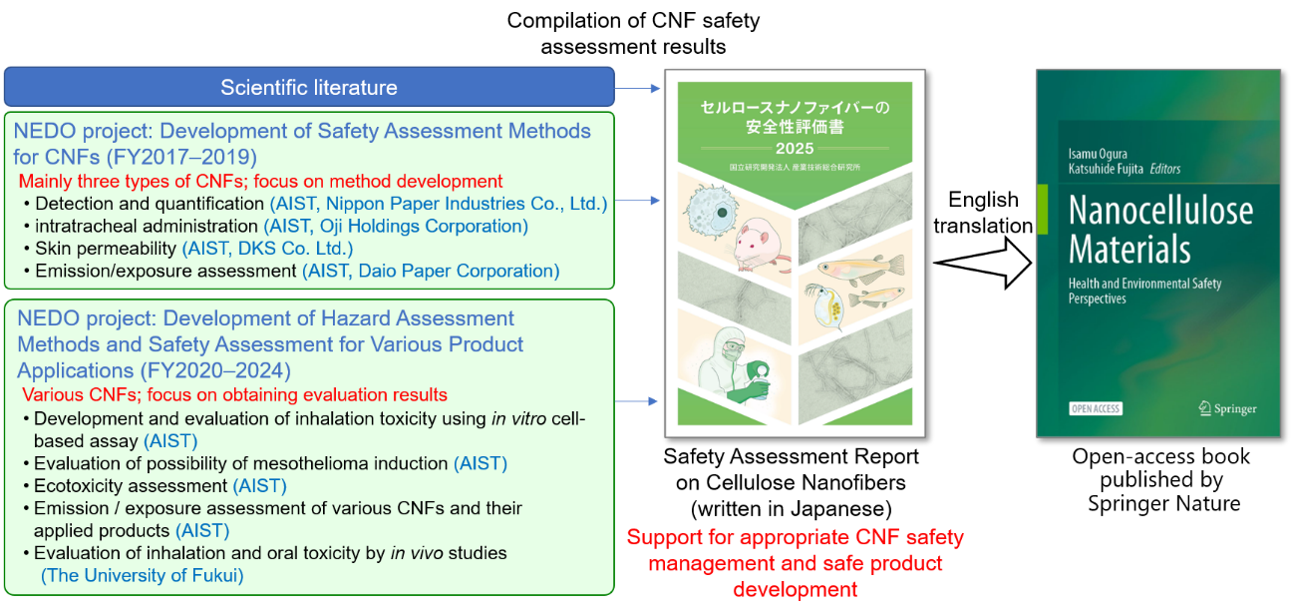
In response to this need, the National Institute of Advanced Industrial Science and Technology (AIST), in collaboration with Oji Holdings Corporation, DKS Co. Ltd., Daio Paper Corporation, and Nippon Paper Industries Co., Ltd., conducted a Japanese national research project commissioned by the New Energy and Industrial Technology Development Organization (NEDO) titled “Development of Technology for Manufacturing Processes of Chemicals Derived from Inedible Plants / Development of Safety Assessment Methods for CNFs” (JPNP13006) from fiscal years 2017 to 2019. This project focused on three types of CNFs and involved the development of methods for detection and quantification, intratracheal administration, skin permeability testing, and emission and exposure assessments. The results were compiled into publicly available resources, including Examples of Detection and Quantification of Cellulose Nanofibers (Japanese version), A Manual for Toxicity Testing of Cellulose Nanofibers (Japanese and English versions), and Examples of Emission and Exposure Assessment of Cellulose Nanofibers and Their Applied Products (Japanese version). These documents can be downloaded from the Download section at the end of this page.
Subsequently, a second NEDO project titled “Cellulose Nanofiber–Related Technology Development to Contribute to a Carbon Cycle Society / Development of CNF Utilization Technology / Development of Hazard Assessment Methods and Safety Assessment for Various Product Applications” (JPNP20009) was carried out from fiscal years 2020 to 2024. Within this project, AIST undertook the following activities:
- Inhalation toxicity assessment using cultured cells applicable to a wide range of CNF types;
- Evaluation of potential mesothelioma risk comparable to that associated with asbestos;
- Ecotoxicity evaluation targeting aquatic organisms (e.g., algae, crustaceans, and fish);
- Emission and exposure assessment of various CNFs and their applied products.
Whereas the 2017–2019 project primarily focused on developing methodologies required for the safety evaluation of three representative CNF types, the 2020–2024 project expanded both the range of CNFs examined and the scope of the evaluation, primarily aiming at obtaining specific assessment results. Furthermore, the latter project included participation from the University of Fukui alongside AIST and incorporated in vivo studies evaluating biological safety following inhalation and oral exposure.
To support businesses handling CNFs, as well as those developing CNF-based applications, we compiled the findings of the NEDO projects on CNF safety assessment together with a comprehensive review of the scientific literature and published the Safety Assessment Report on Cellulose Nanofibers (Japanese version) in December 2022, followed by a revised edition in January 2025.
To further disseminate these findings internationally, we published Nanocellulose Materials: Health and Environmental Safety Perspectives, an open-access book published by Springer Nature, in July 2026. The book is an English edition of the Safety Assessment Report on Cellulose Nanofibers and summarizes current knowledge on the safety of CNFs and other nanocellulose materials, including CNCs.
We hope that these documents and publications will contribute to the safe and responsible use of NCMs and support the development of safe nanocellulose-based products.
 |
Available Publications and Documents
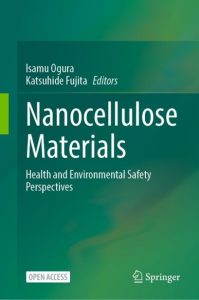
| Nanocellulose Materials: Health and Environmental Safety Perspectives
This book is available as an open-access publication from Springer Nature. |
An English translation of the Safety Assessment Report on Cellulose Nanofibers, providing a comprehensive overview of the safety of CNFs and other nanocellulose materials. The book summarizes findings from scientific literature and national research projects, covering hazard assessment, exposure evaluation, and environmental impacts. |
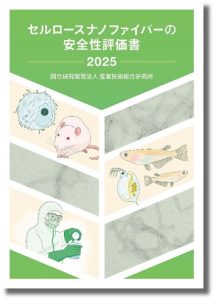
| Safety Assessment Report on Cellulose Nanofibers (Japanese version, published January 2025)
|
A comprehensive review of the safety of cellulose nanofibers (CNFs), integrating findings from scientific literature and national research projects. The report covers toxicity, exposure, environmental impacts, and risk assessment, and provides information to support the safe use and development of CNF-based products. |
Examples of Detection and Quantification of Cellulose Nanofibers (Japanese version, published March 2020)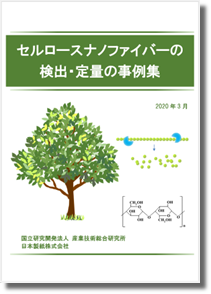
|
An overview of analytical methods for detecting and quantifying CNFs, including acid hydrolysis, enzymatic hydrolysis, and thermal decomposition. The document provides detailed procedures, measurement examples, and key considerations. |
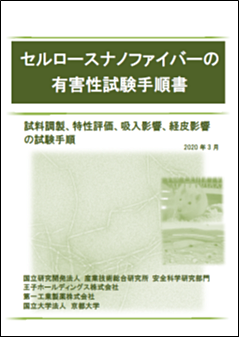
| A Manual for Toxicity Testing of Cellulose Nanofibers (Japanese version, published March 2020)
|
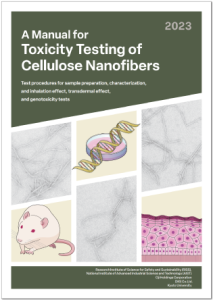
Compilation of procedures for sample preparation, characterization, inhalation testing, and dermal testing for CNF toxicity assessment, along with evaluation results and findings obtained using these methods. |
| A Manual for Toxicity Testing of Cellulose Nanofibers (English version, published February 2023)
|
|
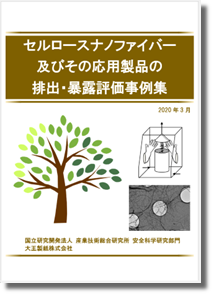
| Examples of Emission and Exposure Assessment of Cellulose Nanofibers and Their Applied Products (Japanese version, published March 2020)
|
A summary of emission and exposure assessment results for CNFs and CNF-based products, including on-site investigations, simulated emission tests of CNF powders and composites, and evaluations of CNF biodegradability. |
Related Scientific Publications
Measurement and Characterization
- Ogura I, Moriyama A, Iizumi Y, Endoh S, Fujita K, Horie M, Okazaki T, Matsuzawa T. Effect of gamma irradiation on cellulose nanofibers. J Wood Sci 2025, 71(1):37. LINK
- Iizumi Y, Kato Y, Okazaki T. Particle size and porosity measurements of cellulose nanofibers in slurries using centrifugal sedimentation. Cellulose 2025, 32, 1597–1605. LINK
- Matsuzawa T, Tai R, Mano H, Ogura I. Applicability of enzymatic and phenol-sulfuric acid methods for determination of cellulose nanofibers in ecotoxicity testing. J Wood Sci 2024, 70(1):17. LINK
- Ogura I, Sugiyama M, Tai R, Mano H, Matsuzawa T. Optimization of microplate-based phenol-sulfuric acid method and application to the multi-sample measurements of cellulose nanofibers. Anal Biochem 2023, 681:11. LINK
Hazard Assessment
- Fujita K, Obara S, Maru J, Kawai Y, Endoh S, Moriyama A. Pulmonary inflammation and immune responses induced by nanocellulose: Insights from in vivoand in vitro Curr Res Toxicol. 2025, 100259. LINK
- Fujita K and Moriyama A. Inhalation toxicity of cellulose nanofibrils: A review of key findings and future directions. Carbohydr. Polym. Technol. Appl. 2025, 11:100913. LINK
- Horie M, Sugino S, Fujita K, Endoh S, Maru J, Matsuzawa T, Ogura I. Evaluation of inflammatory and mesothelioma-related responses in mice following the intraperitoneal administration of cellulose nanofibers. NanoImpact. 2025 10(38):100561. LINK
- Fujita K, Obara S, Maru J, Kawai Y, Endoh S. Pulmonary inflammatory responses and retention dynamics of cellulose nanofibrils. Toxicology. 2025, 511:154038. LINK
- Fujita K, Obara S, Maru J, Endoh S, Kawai Y, Moriyama A, Horie M. Assessing cytotoxicity and biocompatibility of cellulose nanofibrils on alveolar macrophages. Cellulose. 2024, 32:241–260. LINK
- Fujita K (2024) Assessing inhalation toxicity of cellulose nanofibrils. Oleoscience 24(5):197–203. (in Japanese). LINK
- Fujita K, Obara S, Maru J, Endoh S. Effects of advanced nanomaterials on the respiratory system of a murine COPD model. Toxicology Reports. 2023, 11:481–492. LINK
- Horie M, Fujita K, Endoh S, Sugino S, Maru J, Moriyama A, Ogura I. Contaminant microorganisms in the in vitro evaluation of cellular responses of cellulose nanofibers and their microbial inactivation using gamma irradiation. Toxicol Mech Methods. 2023, 33(9):741–754. LINK
- Moriyama A, Ogura I, Fujita K. Potential issues specific to cytotoxicity tests of cellulose nanofibrils. J Appl Toxicol. 2023, 43(1):195–207. LINK
- Fujita K, Obara S, Maru J, Endoh S. Genotoxicity assessment of cellulose nanofibrils using a standard battery of in vitroand in vivo assays. Toxicology Reports. 2022, 9:68–77. LINK
- Fujita K, Obara S, Maru J, Endoh S. Pulmonary inflammation following intratracheal instillation of cellulose nanofibrils in rats: comparison with multi-walled carbon nanotubes. Cellulose. 2021, 28:7143–7164. LINK
- Sai T, Maru J, Obara S, Endoh S, Kajihara H, Fujita K. Screening of preservatives and evaluation of sterilized cellulose nanofibers for toxicity studies. J Occup Health. 2020, 62(1):e12176. LINK
- Sai T and Fujita K, A review of pulmonary toxicity studies of nanocellulose. Inhal Toxicol. 2020, 32(6):231–239. LINK
Emission and Exposure Assessment
- Ogura I, Kotake M. Dustiness and aerosol characteristics of nanocellulose powders: Implications for workplace exposure and safety management. NanoImpact 2026, 41: 100610. LINK
- Ogura I, Kotake M, Kuboyama T, Kajihara H. Measurements of cellulose nanofiber emissions and potential exposures at a production facility. NanoImpact 2020, 20:100273. LINK
Ecological Assessment
- Mano H, Tai R, Moriyama A, Iizumi Y, Matsuzawa T, Okazaki T, Ogura I. Dilution effect of TEMPO-oxidized cellulose nanofibers on reproduction of Daphniamagna. Ecotoxicol Environ Saf. 2025 1;294:118101. LINK
- Tai R, Ogura I, Okazaki T, Iizumi Y, Mano H. Algal growth inhibition test with TEMPO-oxidized cellulose nanofibers. NanoImpact 2024, 34, 100504. LINK
- Tai R, Ogura I, Okazaki T, Iizumi Y, Mano H. Acute toxicity tests of TEMPO-oxidized cellulose nanofiber using Daphniamagna and Oryzias latipes. Cellulose 2024, 31, 2207–2220. LINK
Tai R, Ogura I, Mano H. Current status and considerations of ecotoxicity testing methods for cellulose nanofibers. Jpn J Environ Toxicol 2022, 25, 32–47. (in Japanese) LINK